
I recall a patient who came to my clinic last year. She was a marketing professional in her mid-thirties, busy with work, managing her home, and trying to conceive. A routine ultrasound for a different reason had picked up something unexpected—a small growth inside her uterus. The radiologist had called it a "possible endometrial polyp."
She sat across from me with a folder full of ultrasound images and a face full of anxiety. "What is it? Is it cancer? Will I need surgery? Can I still have a baby?" These questions tumbled out one after another.
This is a conversation I have had hundreds of times. Uterine polyps are common, yet they bring a wave of fear that is often disproportionate to their actual clinical significance. The good news is that modern medicine offers a solution that is safe, effective, and far less intimidating than most patients imagine.
Let me walk you through what uterine polyps are, why we remove them, and what you can expect from the procedure.
What Are Uterine Polyps?
Uterine polyps, also called endometrial polyps, are overgrowths of the tissue that lines the inside of your uterus. They attach to the uterine wall by a stalk or a broad base and project into the cavity. In simple terms, they are small, soft, fleshy bumps that grow in the womb.
In my practice in South Delhi, I see these most commonly in women in their 30s to 50s. Hormones, particularly oestrogen, play a major role in their development. That is why they are more frequent during the reproductive years and in perimenopause.
The vast majority over 95% are benign. However, they can cause symptoms that disrupt daily life, and in some cases, they can interfere with fertility.
Symptoms That Should Not Be Ignored
Not every polyp brings symptoms along with it. Sometimes people find them sort of by accident during an ultrasound or a hysteroscopy, done for a totally different reason. But if symptoms do show up, they usually look like this, more or less:
Abnormal bleeding this can mean heavy menstrual bleeding, spotting between periods, bleeding after intercourse, or even bleeding after menopause
Watery discharge, or vaginal discharge that’s stained with blood
Pelvic pain or cramping less common, but it can happen especially if the polyps get bigger
Trouble conceiving polyp tissue can behave like a kind of “foreign presence” and interfere with embryo implantation
If any of these things happen to you, don’t brush it off. A straightforward evaluation can help you understand what’s going on and give you some calm, and relief.
Why Remove Uterine Polyps?
You might wonder: if most polyps are benign, why remove them at all?
The answer is kinda multi-layered. First, even harmless polyps can still cause strong symptoms heavy bleeding that messes with your day to day life, or occasional spotting that leaves you with ongoing concern. Second, polyps can mess with fertility as well, so it can become harder to conceive.They act as a physical barrier, preventing implantation, or they create inflammation that makes the uterine lining less receptive. Third, while the risk of malignancy is low, it is not zero. In postmenopausal women, the risk is slightly higher, and removal with tissue examination is the only way to be certain.
Finally, removing a polyp eliminates the uncertainty. You no longer have to wonder what that growth is, or whether it will grow larger. You get a definitive diagnosis and a clean slate.
The Procedure: What Actually Happens
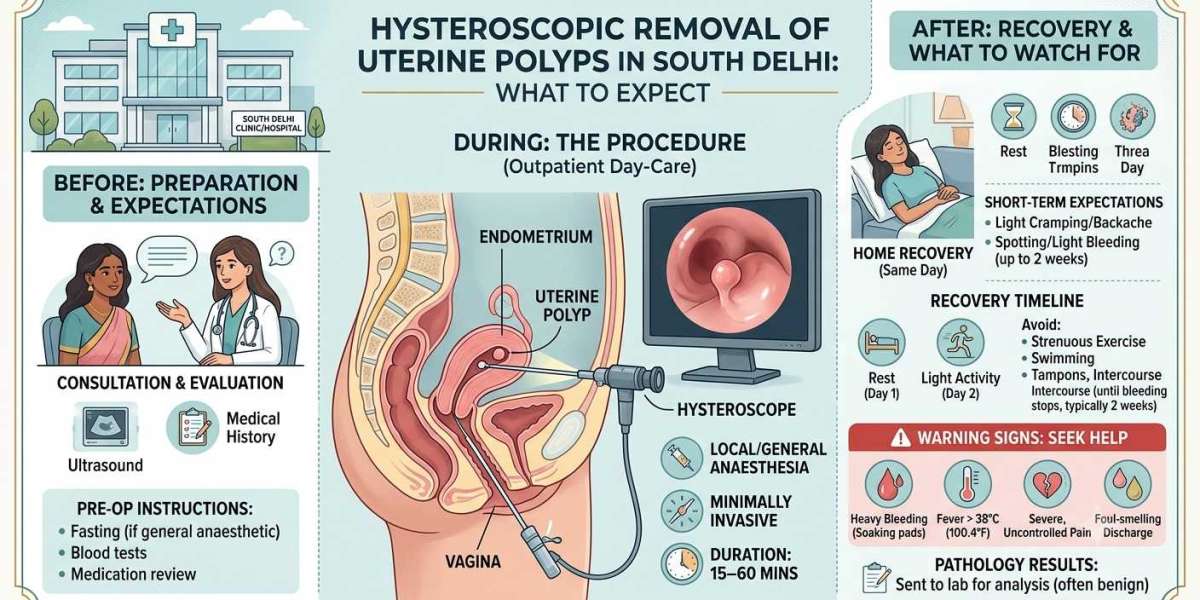
The taking out of uterine polyps is often called hysteroscopic polypectomy. It’s a minimally invasive thing, done through the vagina, so there are no abdominal incisions or anything like that.
Before the procedure, you’ll have a consultation. In that visit we talk through your symptoms, your past health background and all the medications you’re currently taking. An ultrasound is used to check the polyp size and where exactly it sits inside. Usually it’s planned in the first half of your menstrual cycle, because the uterine lining is thinner then and the view is clearer.
On the actual day you come into the clinic. In most cases you do not need to stay overnight, it’s basically outpatient. Depending on how complex the polyp is, you might get local anaesthesia or mild sedation, sometimes both depending on comfort.
First a speculum is inserted, similar to what happens during a routine Pap smear. After that a slender, lighted scope, also called a hysteroscope, is gently guided through the cervix into the uterus. This gives a clear magnified view of the uterine cavity on a monitor. Then, with delicate tools that go through the hysteroscope—like graspers or a bipolar electrode—the polyp is removed very carefully from its base. The whole business usually takes something around 15 to 30 minutes. And afterward, there are no cuts, no stitches, and no scars.
The removed tissue is always sent for histopathological examination. This is a critical step that I never skip. The report confirms the nature of the polyp and rules out any malignancy.
What to Expect After the Procedure
Recovery from hysteroscopic polypectomy is remarkably gentle. You may experience mild cramping, similar to menstrual cramps, which settles within a few hours. Light spotting or a watery discharge is normal for a few days. Pain is minimal and can be managed with simple pain relievers.
I advise my patients to:
- Avoid tampons for about a week
- Avoid sexual intercourse for at least 7 to 10 days
- Avoid heavy lifting or vigorous exercise for a few days
- Rest for the remainder of the day after the procedure
- Most women return to their normal activities the next day.
Potential Risks and Complications
Like any kind of procedure, hysteroscopic polypectomy does come with certain risks even if they are rare. Uterine perforation happens in under 1% of cases, and it will typically resolve by itself. Infection is also uncommon when a proper sterile technique is used, usually in the background it stays quiet. Bleeding is typically minimal.
I always discuss these risks with patients beforehand so they can make an informed decision.
Results and Follow-Up
The pathology report takes about a week. In the vast majority of cases, it confirms a benign endometrial polyp. For those trying to conceive, I often see improved fertility outcomes after polyp removal. The uterine cavity becomes smooth and free of obstructions.
I recommend doing a follow up ultrasound in about three to six months , just to see if there is any regrowth. Recurrence shows up in roughly 10 to 15% of patients, and if you keep regular monitoring then early detection is much easier, ok.
When to Call a Gynecologist
If you are dealing with heavy periods, irregular bleeding, or some trouble getting pregnant, don’t wait too long. A quick, simple check up can make a whole lot of difference really, even when things feel confusing.
Call a Gynecologist in South Delhi today if you have concerns about uterine polyps. Early diagnosis allows for timely treatment, less anxiety, and better outcomes.
Book your consultation with best gynecologist in south delhi at our clinic. Our approach combines advanced technology, clinical expertise, and genuine patient care.
A Final Word
Finding a uterine polyp can be unsettling. The word sounds serious, and the uncertainty weighs on your mind. But here is the reality: uterine polyps are one of the most manageable gynaecological conditions. The removal procedure is safe, quick, and effective. Recovery is short. Relief is lasting.
I have seen countless patients come into my clinic with worry, on their faces, and then somehow walk out with smiles of relief. Later they get back to their routines, their families, and those little or big dreams. symptoms feel gone, and that uncertainty fades
Your health is your foundation. Don't let fear or delay stand between you and the care you truly deserve
Dr. Amrita Singh works in Lajpat Nagar, South Delhi, with a lot of experience in minimally invasive gynaecological surgery, like hysteroscopy as well
If you want a full, careful evaluation call the Gynecologist in South Delhi, today and get in touch with Dr. Singh at her clinic. Book your consultation with the best gynecologist in south delhi, and take that first step toward clarity and a calmer mind