
Hiring inflatables for an event sounds straightforward until you start thinking about the detail. How many units do you actually need? Will one bouncy castle keep 150 guests entertained, or will you end up with a queue that stretches across the car park and a crowd of bored adults standing around the edges? Getting the number of inflatables right is one of the most important decisions an event planner makes — and one of the most commonly underestimated.
This guide gives you a practical, numbers-led framework for working out exactly how many inflatables you need based on your guest count, event duration, age mix and activity type — so you can plan your inflatables hire with confidence and deliver an event that keeps everyone moving.
Why Getting the Number of Inflatables Right Matters
Too few inflatables and your event develops the one problem no planner wants: queues. Long queues kill event energy, frustrate guests and make the entertainment feel like a bottleneck rather than a highlight. Children disengage quickly when they have to wait more than a few minutes for their turn; adults drift off to the bar or the seating area and never come back.
Too many inflatables and you have overspent your budget on units that sit partially used — money that could have gone on better catering, a better venue or additional activity variety. The goal is the sweet spot: enough inflatables hire capacity to keep your guest numbers flowing without unnecessary redundancy.
The right number depends on four variables: how many guests you have, how long the event runs, what age groups are attending and what type of inflatables you are hiring. Each of these factors is covered in detail below.
The Baseline Rule: Inflatables Capacity Per Hour
Before getting into specific recommendations by guest count, it helps to understand how inflatable capacity is calculated in practice.
Most inflatables — bouncy castles, bungee runs, assault courses — operate on a cycle basis. Users enjoy the activity for a set time (typically two to five minutes per go depending on the unit), then rotate off to allow the next group on. The number of users per cycle multiplied by the number of cycles per hour gives you the realistic hourly throughput of each unit.
As a working baseline:
- A standard bouncy castle handles approximately 6–8 users per cycle at 3 minutes per cycle — giving a realistic throughput of around 120–160 users per hour under active management
- A bungee run is a head-to-head unit handling 2 users per cycle at 2–3 minutes — giving a throughput of approximately 40–60 users per hour
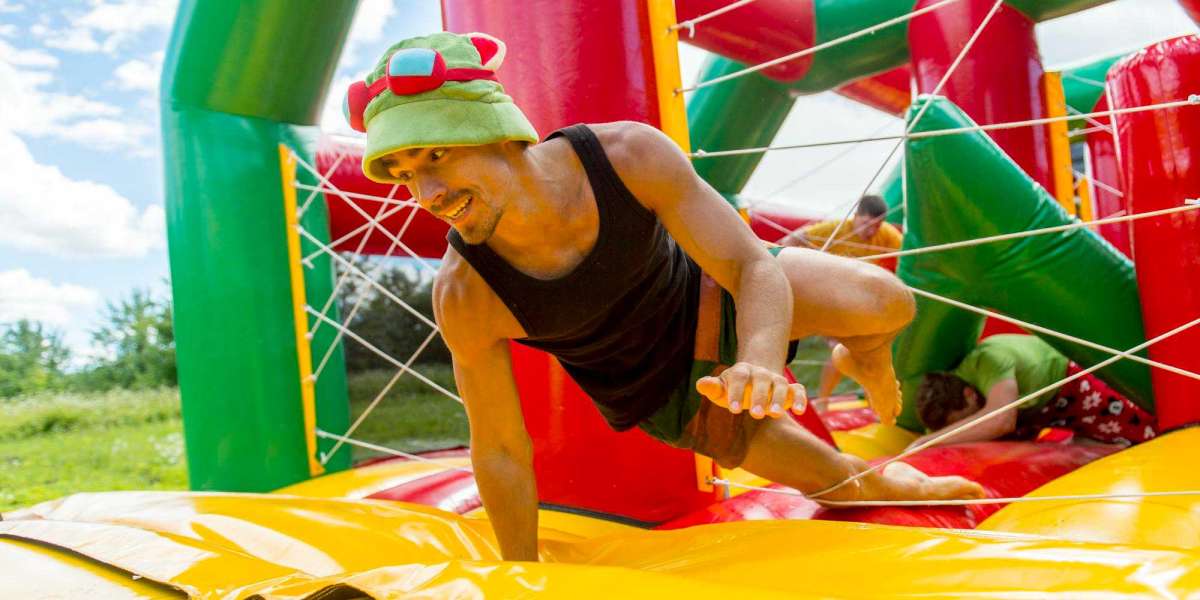
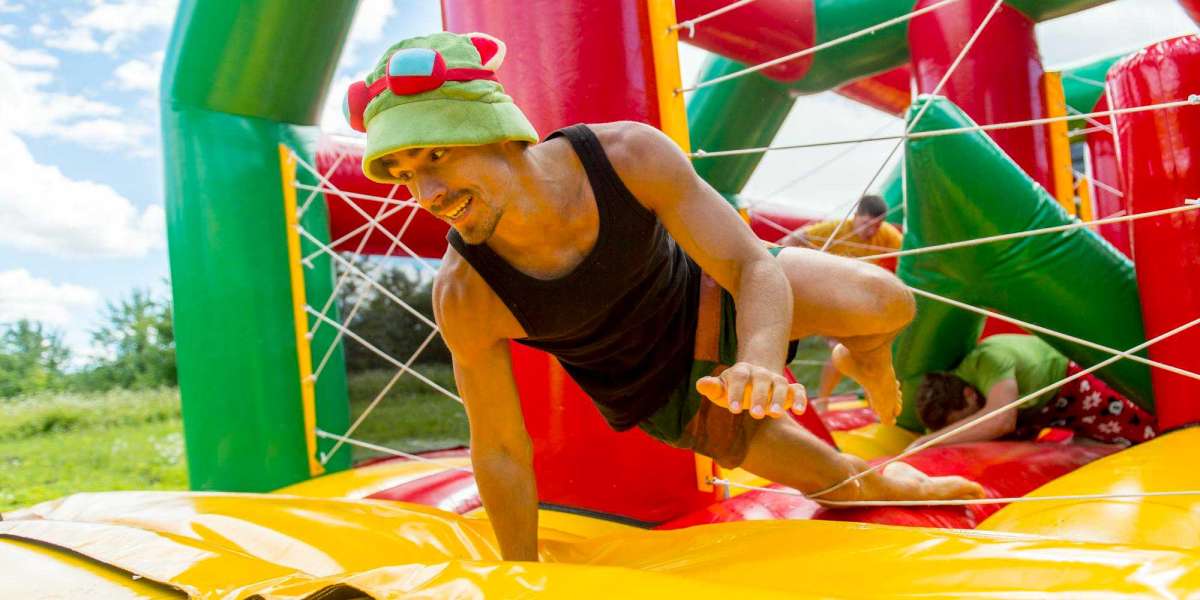
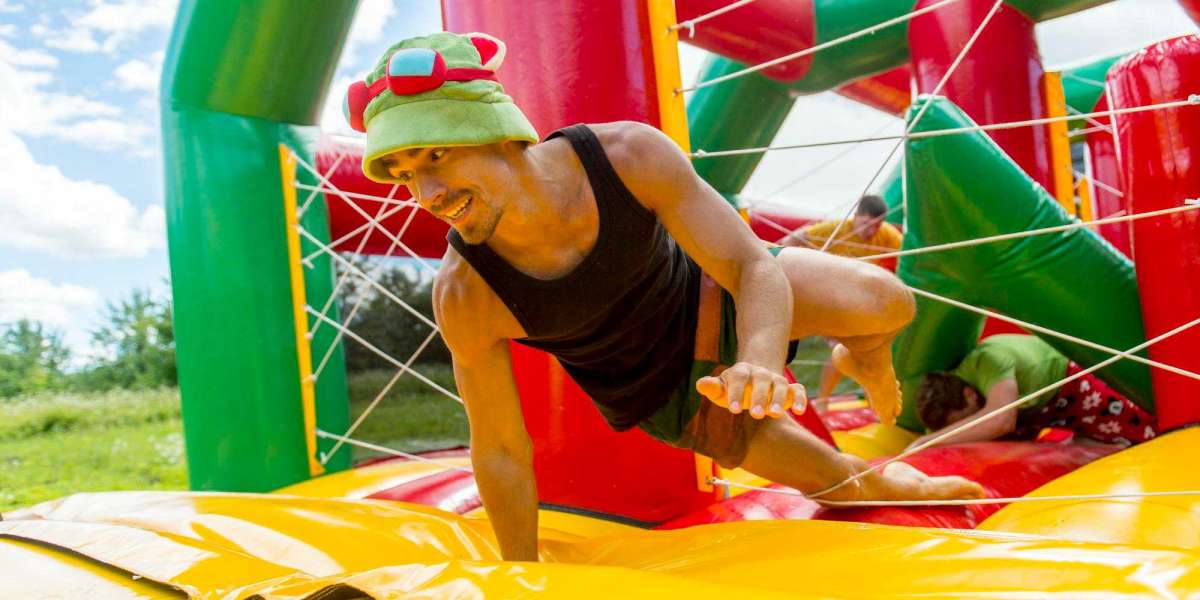
- An inflatable assault course typically handles 2–4 users simultaneously at 3–4 minutes per run — giving a throughput of approximately 40–80 users per hour depending on length and complexity
- A sumo suit or gladiator duel station handles 2 users per bout at 2–3 minutes — approximately 40–60 participants per hour
These throughput figures assume active supervision and rotation management. Without an operator managing flow, throughput drops significantly — users stay on longer, groups pile on together and the queue builds faster than the unit can clear it.
Inflatables Hire Recommendations by Guest Count
Events of Up to 50 Guests
For smaller events of up to 50 guests — a children's birthday party, a small corporate away day, a village fundraiser — a single well-chosen inflatable is typically sufficient, provided the event runs for three or more hours and the guest mix is relatively consistent in age and activity preference.
Recommended:
- 1 large bouncy castle or inflatable activity unit for a children's event
- 1 head-to-head unit (bungee run, gladiator duel, sumo suits) for an adult or corporate event
- 2 units if the age mix is wide — one child-focused, one adult-focused
Key consideration: At 50 guests with a single bouncy castle running at 120–160 users per hour throughput, every guest could theoretically participate multiple times in a three-hour event window. The queue risk at this scale is low, provided the inflatable is actively managed.
Events of 50–100 Guests
At 50–100 guests, a single inflatable starts to create meaningful queue pressure — particularly if the event runs for only two to three hours and the activity is the primary entertainment rather than one element of a broader programme.
Recommended:
- 2 inflatables for a children's event of this size — a bouncy castle plus an assault course or slide gives activity variety and doubles your throughput capacity
- 2–3 units for a mixed adult and children's event — one child-specific, one adult-specific (bungee run, human table football, sumo suits) and optionally a third shared unit
- 2 units for a corporate event — two head-to-head or team competition units running simultaneously maintains energy and competitive momentum without creating the bottleneck that a single unit generates at this guest count
Key consideration: At 100 guests, two inflatables with combined throughput of 200–300 users per hour covers your guest count comfortably within a three-hour window even accounting for guests who choose not to participate. This is the threshold at which activity variety starts to matter as much as raw capacity.
Events of 100–200 Guests
At 100–200 guests, inflatables hire planning needs to account not just for capacity but for the event experience as a whole. This is the guest count at which a single inflatable creates an obvious and persistent queue that damages event atmosphere — and at which the right mix of units becomes as important as the number.
Recommended:
- 3–4 inflatables for a children's event — a mix of bouncy castle, assault course, slide and an additional activity unit (obstacle course, inflatable sports game) gives capacity and variety that sustains children's engagement across a full event
- 3–5 units for a mixed-age or corporate event — consider a combination of high-throughput units (bouncy castle, assault course) and lower-throughput competitive units (bungee run, sumo suits, gladiator duel) that deliver entertainment value even for guests watching rather than participating
- Activity stations rather than a single focus — at 150+ guests, spreading inflatables hire across the venue space rather than concentrating units in a single area improves flow, reduces local congestion and creates a more dynamic event environment
Key consideration: At 200 guests with four inflatables running at combined throughput of 400–600 users per hour, you have capacity to cycle every guest through multiple activities in a four-hour event. The management challenge at this scale shifts from capacity to flow — ensuring guests know what is available, where it is and how to access it without congestion.
Events of 200–500 Guests
Large-scale events of 200–500 guests require an inflatables hire plan that thinks in terms of an activity zone rather than individual units — a coordinated layout of multiple inflatables that collectively create a destination experience rather than a series of isolated attractions.
Recommended:
- 5–8 inflatables for events of 200–350 guests — a mix of high-capacity units for general participation (large bouncy castles, extended assault courses) and competitive or novelty units (bungee run, human table football, sumo suits, mechanical bull) that generate crowd entertainment value
- 8–12 units for events of 350–500 guests — at this scale, think in terms of an inflatable activity village with clearly defined zones: children's area, adult/corporate activity area, team competition area and spectator-friendly competitive units
- Consider a dedicated host or MC — at 300+ guests across multiple inflatables, a host who manages activity rotation, runs competitions and maintains crowd energy transforms a collection of inflatables into a coherent event programme
Key consideration: At 500 guests, inflatables hire planning should include a site layout drawing that maps unit placement, spectator areas, queuing routes and access paths for setup and breakdown. Safety management and crowd flow are as important as unit selection at this scale.
Events of 500 Guests and Above
At 500+ guests, inflatables hire becomes a major event infrastructure decision that requires early planning, site survey and professional event management input. The number of units required at this scale depends heavily on the event format — a festival-style open-access event where guests dip in and out is different from a structured event where all guests are expected to participate during a defined activity window.
Recommended:
- Work with your inflatables hire company to conduct a site survey and develop a formal activity plan — unit selection, layout, staffing, safety management and logistics all require professional planning at this scale
- Plan for 12 or more units across a varied activity mix — including high-capacity throughput units for general participation, competitive head-to-head units for crowd entertainment, and spectator-friendly formats that engage guests who are watching rather than participating
- Build in sufficient staffing — each inflatable requires a trained operator; at 12+ units, your inflatables hire provider should be supplying a dedicated event management team rather than individual unit operators
Inflatables by Age Group: What Works for Who
Guest age mix is one of the most important factors in inflatables hire selection — the wrong unit for the wrong age group generates low participation and wasted budget.
Under 5s: Soft play inflatables, toddler bouncy castles and low-height slides specifically designed for young children; standard bouncy castles present fall height and safety risks for under 5s without appropriate supervision
5–12 year olds: The core bouncy castle and assault course demographic — high energy, high participation, excellent throughput; consider competitive formats (racing slides, relay assault courses) that add a game structure to the activity
Teenagers: The age group most likely to disengage from inflatables perceived as for younger children; competitive, head-to-head and novelty formats work best — bungee run, gladiator duel, mechanical bull, human table football; avoid standard bouncy castles which many teenagers consider beneath them
Adults and corporate groups: Head-to-head competitive units (bungee run, sumo suits, gladiator duel, human table football) generate the strongest adult participation; the competitive element and the comedy value of sumo suits and gladiator formats create crowd entertainment as well as participant activity
Mixed all-age events: Plan for dedicated zones by age group rather than shared units — a children's zone with age-appropriate inflatables running alongside an adult/family zone with competitive units serves the whole audience better than compromise units that work partially for everyone
Event Duration and Its Effect on Inflatables Hire Needs
Event duration directly affects how many inflatables you need to achieve satisfactory participation levels. A two-hour event with 150 guests needs more inflatables per head than a six-hour event with the same guest count, because the shorter time window compresses participation demand.
As a working guide:
- 2-hour event: Plan for approximately 1 inflatable per 30–40 guests
- 3-hour event: Plan for approximately 1 inflatable per 50–60 guests
- 4-hour event: Plan for approximately 1 inflatable per 60–80 guests
- Full-day event (6+ hours): Plan for approximately 1 inflatable per 80–100 guests
These are starting-point ratios rather than fixed rules — activity type, age mix and event format all affect them. A bungee run serves fewer guests per hour than a bouncy castle, so a bungee run-focused event needs more units per head than a bouncy castle-focused event.
Practical Tips for Planning Your Inflatables Hire
Book early for peak dates — summer weekends, school holiday periods and the Christmas party season see high demand for inflatables hire near me; the best units book out weeks or months in advance. If your event falls in peak season, confirm your inflatables hire booking as early as possible.
Ask about operators — unmanned inflatables run at lower throughput, create safety risks and reduce the quality of the event experience; always confirm whether operators are included in your inflatables hire package or available as an add-on.
Check venue suitability — indoor inflatables hire has specific ceiling height, floor surface and access requirements; confirm your venue dimensions and access routes with your inflatables hire provider before finalising unit selection.
Plan your layout — units placed too close together create congestion and safety risks; allow adequate spectator and queuing space around each inflatable and confirm your site layout with the provider before the event day.
Have a wet weather plan — outdoor inflatables cannot operate safely in high winds or heavy rain; discuss the provider's weather cancellation policy and have an alternative programme element ready if outdoor inflatables hire is affected by weather.
Frequently Asked Questions
How many inflatables do I need for 100 guests?
For a three to four hour event with 100 guests of mixed ages, two to three inflatables is the standard recommendation — one high-capacity unit such as a bouncy castle or assault course, and one or two competitive or novelty units depending on the age profile. This gives sufficient throughput capacity for all guests to participate multiple times while providing activity variety that sustains engagement across the event.
Can one bouncy castle handle 200 guests?
A single bouncy castle can theoretically cycle 200 guests through in a three to four hour event window, but the queue experience will be poor and guest satisfaction will suffer. For 200 guests, three to four inflatables across a mix of activity types is the recommended minimum — this provides both the capacity and the variety that sustains a large guest count across a full event.
What is the best inflatable for a corporate event?
Head-to-head competitive inflatables — bungee run, sumo suits, gladiator duel, human table football — generate the strongest engagement and entertainment value at corporate events. The competitive format encourages participation from guests who might not engage with standard bouncy castle inflatables, and the comedy value of sumo suits and gladiator formats creates crowd entertainment that involves even non-participants.
How far in advance should I book inflatables hire near me?
For summer events, school fairs and Christmas party season bookings, four to eight weeks in advance is the minimum recommended booking lead time for popular units. For large events requiring multiple inflatables, or events on high-demand dates such as bank holiday weekends, booking two to three months in advance is advisable to secure the specific units and operator staffing your event requires.
Ready to Plan Your Inflatables Hire?
Whether you are planning a children's birthday party for 30 guests or a corporate away day for 300, getting the number and mix of inflatables right makes the difference between an event that flows and one that frustrates. Our team has experience planning inflatables hire for events of every scale — from single-unit bookings to full activity village installations — and we can help you build a hire package that fits your guest count, your venue and your budget.
Get in touch to discuss your event requirements, check availability and get a quote for inflatables hire near you. We will help you work out exactly what you need and make sure your event day runs exactly as planned.