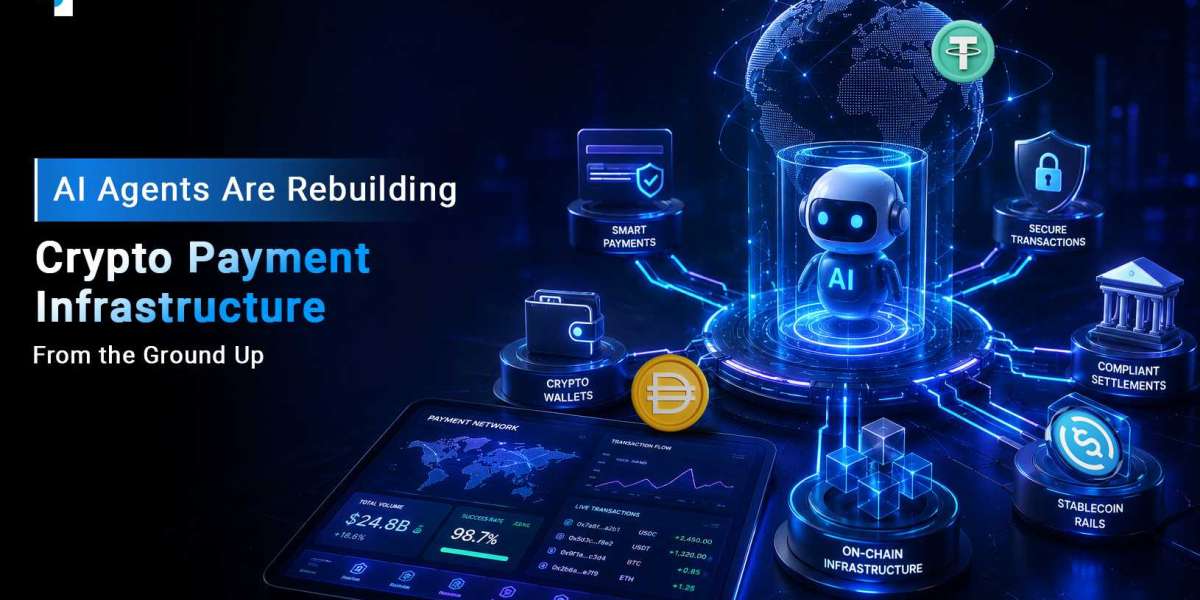

For most of crypto's history, a "payment" meant a human clicking a button. That assumption is quietly breaking down. Across DeFi protocols, SaaS platforms, and API marketplaces, autonomous AI agents have started paying each other directly — for compute, for data, for access without a person in the loop.
By April 2026, roughly 69,000 active agents on the x402 protocol alone had processed more than 165 million transactions worth over $50 million, according to industry trackers. Visa has publicly called agentic commerce a mainstream force for 2026. Coinbase, Google (through its AP2 standard), Mastercard, PayPal, and the Ethereum Foundation are all backing frameworks that let software agents transact on-chain without waiting for human approval at every step.
This shift matters because traditional cryptocurrency payment gateway architecture was never designed for machine-speed, machine-initiated transactions. AI agents need something different: instant micropayments, programmable spending limits, real-time fraud logic, and settlement rails that don't choke on thousands of tiny transactions per second.
The Current Landscape: Payments Built for People, Not Machines
Most existing gateways still assume a human initiates every transaction. That model is showing its limits as agent-to-agent commerce grows.
Three gaps stand out:
- Latency mismatch. Agents negotiate and settle in milliseconds; legacy gateways were tuned for human-paced checkout flows.
- No native micropayment support. Paying fractions of a cent per API call at scale requires infrastructure most gateways weren't built for.
- Static risk controls. Fraud and compliance checks designed around human behavior patterns don't map well onto autonomous, high-frequency agent activity.
The result: a growing number of crypto startups and fintech teams are re-architecting their payment stacks rather than patching old ones.
Emerging Technologies Reshaping the Stack
Stablecoins as the Default Settlement Layer
With the total stablecoin market cap surpassing $321 billion in 2026 and circulation projected to cross $1 trillion by year-end, stablecoins have become the practical settlement currency for agent transactions. On-chain stablecoin transfers cost a fraction of a cent, which is precisely the economics AI agents need when they're making thousands of small payments for data, compute, or API access.
Machine-Native Payment Protocols
Standards like HTTP 402-based x402 and Google's AP2 are giving agents a common language for initiating and settling payments. Rather than routing through a human-facing checkout, an agent can request a resource, receive a payment prompt, and settle instantly on-chain.
Programmable Spending Guardrails
Smart contract-based spending limits, multi-agent approval logic, and real-time anomaly detection are becoming standard requirements — not nice-to-haves — as agents are granted more autonomy over wallets and budgets.
Market Opportunity: Why This Is a Business Conversation, Not Just a Technical One?
The cryptocurrency payment gateway market reached an estimated $2.39 billion in 2026 and is projected to grow at roughly 18.7% CAGR through 2030, reaching close to $4.74 billion. Layer in agentic commerce and stablecoin settlement growth, and the addressable opportunity for infrastructure providers expands considerably.
For founders and enterprises, this creates a genuine window. Businesses that treat crypto payment gateway development as a strategic bet — not a checkbox integration — are positioning themselves ahead of a wave that Visa, Mastercard, and major exchanges are already building toward. Demand for crypto payment gateway development services has shifted noticeably toward flexibility: startups want infrastructure that can handle both human customers and autonomous agents on the same rails, not a rigid, single-purpose checkout tool.
Key Challenges Businesses Need to Plan For
- Security exposure. Researchers have documented real losses, including incidents where compromised routing exposed credentials and drained agent-controlled wallets of hundreds of thousands of dollars.
- Regulatory ambiguity. Rules governing autonomous financial agents remain unsettled in most jurisdictions.
- Interoperability. Agents built on different protocols (x402, AP2, proprietary systems) need gateways that bridge standards rather than lock into one.
- Trust verification. Confirming an agent acting on a wallet is authorized — and hasn't been hijacked — is a new category of risk entirely.
Business Benefits of Getting This Right Early
Enterprises and Web3 founders that invest in agent-ready payment infrastructure now stand to gain:
- Lower transaction costs through stablecoin-based settlement versus card-network fees
- Faster go-to-market for products that serve both retail users and B2B/agent-driven workflows
- A defensible position as agentic commerce standards consolidate
- Reduced integration friction when scaling into new markets or verticals
Real-World Applications Taking Shape
AI agents are already handling subscription renewals, automated procurement, on-chain treasury rebalancing, and machine-to-machine data purchases — all settled via stablecoins. Several blockchain enterprises are piloting white label crypto payment gateway development approaches specifically because they need infrastructure that can be customized quickly for agent-driven use cases without building from zero. Antier is among the blockchain technology providers actively exploring this space, contributing to the broader conversation around how gateways should evolve to support both human and machine-initiated transactions.
Future Outlook: What the Next Two to Three Years Likely Look Like
Expect three shifts to accelerate: tighter integration between agent frameworks and stablecoin rails, standardized authorization models for agent-controlled wallets, and payment gateways that treat "agent" as a first-class user type alongside "human." Any crypto payment gateway development company that ignores this shift risks building infrastructure for yesterday's transaction patterns.
Conclusion
The transition from human-initiated to agent-initiated crypto payments isn't a distant trend — it's already processing millions of transactions today. As Web3 adoption accelerates, businesses that invest in scalable blockchain infrastructure today will be better positioned to capitalize on tomorrow's digital economy.