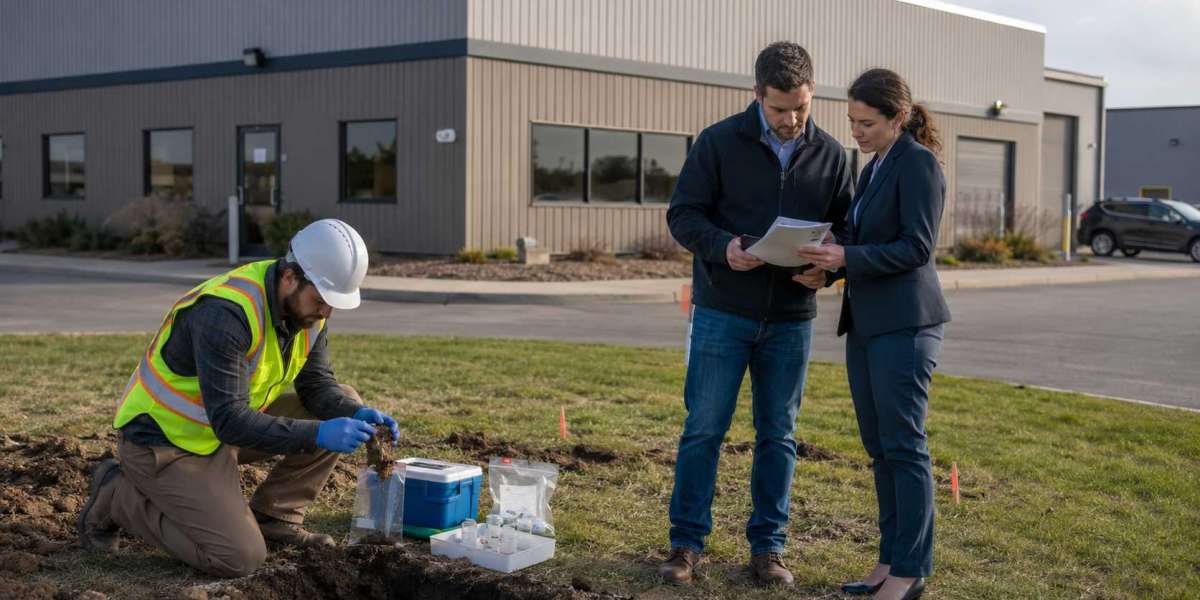

A property doesn't have to look dirty to be a financial liability. Some of the costliest environmental problems in Canadian real estate sit under a well kept lawn or behind a freshly painted warehouse wall, invisible until someone digs, tests, or tries to sell.
That gap between what a property looks like and what it's actually carrying is where environmental liability lives. Whether you're buying a small commercial lot in Saskatchewan, refinancing an industrial building in Alberta, or inheriting a family property in Manitoba, that liability tends to follow the land itself, not just the person who caused it years earlier.
Most buyers think about environmental risk in terms of health or regulatory trouble. That's fair, but it misses half the picture. Environmental liability also shapes something far more immediate: what a bank is willing to lend against the property, and what a future buyer is willing to pay for it. Those two factors, financing and resale value, are where the consequences of contamination actually land on an owner's balance sheet.
What Does Environmental Liability Actually Mean for a Property Owner?
In Canadian environmental law, liability generally attaches to whoever owns or controls the contaminated land at the time it's discovered. It doesn't matter much who caused the contamination decades earlier. People sometimes call this the “polluter pays” principle when discussing government policy, but in practice it often ends up being closer to “current owner pays,” since the original polluter may be long gone, dissolved, or simply impossible to trace.
That distinction catches a lot of buyers off guard.
Common Ways Liability Attaches to a Property
- A former dry cleaner, fuel station, or auto repair shop operated on the site decades before the current building went up
- Fill material brought in for grading or landscaping turns out to be contaminated
- Groundwater contamination migrates onto the property from a neighbouring site
- Underground storage tanks were decommissioned improperly and left in the ground
None of this shows up on a walk-through. That's the core problem environmental liability creates for owners. It's a risk you can inherit quietly, the moment you take title, without ever having done anything wrong yourself.
How Do Buyers Find Out About Liability Before It Becomes Theirs?
This is exactly what environmental due diligence is built to catch early, before a purchase closes rather than after. A properly documented historical review of a property, covering past ownership records, aerial photos, fire insurance plans, and regulatory files, can flag warning signs long before anyone breaks ground or drills a test well.
More buyers across Alberta and British Columbia are now building this step directly into their purchase agreements, treating a thorough environmental site assessments in Calgary and across the province as a standard condition rather than an optional extra. Getting that report done before closing gives a buyer room to renegotiate price, walk away, or plan cleanup costs into their financing, instead of discovering a problem once they already own it. Skipping the step doesn't make the risk go away. It just moves the discovery point to a far more expensive place in the timeline.
How Many Properties in Canada Actually Carry This Risk?
The scale of contamination across the country is bigger than most people assume. According to a 2024 federal audit report, there are roughly 24,000 known or suspected contaminated sites across Canada, with about 2,600 of them located in northern Canada alone, where remediation costs are disproportionately high. The federal government reported an estimated $2.48 billion in environmental liability tied to contaminated sites under its own custodianship in a single fiscal year.
That figure only covers federally owned land. Provincial, municipal, and privately held contaminated sites, including old fuel depots, industrial yards, and agricultural chemical storage areas, add considerably more to the national picture, though they're tracked through separate systems and don't roll up into one clean number.
Does Contamination Actually Show Up in the Sale Price?
Yes, and this has been measured directly rather than just assumed. A hedonic pricing study of residential properties near the Sydney Tar Ponds and Coke Ovens sites in Nova Scotia found that nearby contamination had a clear negative effect on home values. Interestingly, the effect was mostly confined to properties within a few hundred metres of the contaminated land, rather than spreading evenly across the wider market.
That localized pattern tends to hold up in commercial deals too, even when it's harder to measure formally. A building doesn't need to sit directly on contaminated soil to lose value in a buyer's eyes. Proximity, stigma, and plain uncertainty about future liability all weigh on what a buyer or appraiser is willing to offer, sometimes long after the actual contamination has been addressed.
Why Do Lenders in Alberta, British Columbia, and Manitoba Insist on an Assessment Before Approving a Mortgage?
Lenders aren't asking for environmental paperwork out of caution for its own sake. Canadian lender liability under environmental law has developed through decades of case law, and banks have learned the hard way that a contaminated property used as loan collateral can become their problem too if things go sideways. An explainer published by Canada's Business Development Bank walks through why lenders build environmental conditions into commercial financing as a matter of standard practice, not a special request reserved for obviously risky properties.
What Lenders Are Actually Checking For
- Contamination can significantly reduce the value of the collateral backing the loan
- Cleanup obligations can attach to whoever holds title, including a lender that later forecloses
- Redevelopment or resale restrictions on a contaminated property make it a weaker security position
- Lenders in Alberta and Saskatchewan increasingly see former fuel storage and agricultural chemical handling as flags worth checking, given how common those land uses were historically
For a buyer, this means the environmental report isn't just a box to tick for the seller's benefit. It's often the document standing between an accepted offer and an approved mortgage.
What Happens If Contamination Surfaces After You Already Own the Property?
This is where things get expensive fast, and where owners in Manitoba, Saskatchewan, and elsewhere often wish they'd asked more questions before closing. Once contamination is confirmed, an owner is generally on the hook for addressing it, whether that means limited soil removal, groundwater monitoring over several years, or a full remediation plan involving regulators and environmental consultants.
The good news is that this isn't usually an all-or-nothing situation. Working through a structured plan for managing contaminated sites and remediation typically starts with confirming the extent of the problem, then scoping a response that matches the actual risk level rather than assuming the worst case. A small, well-contained issue from an old fuel tank is a very different project than a large-scale industrial contamination spreading across a property line. Owners who get ahead of the problem, rather than waiting for a regulator or a future buyer to force the issue, generally end up with lower costs and far more control over the process.
Can Insurance Cover Environmental Contamination on a Property?
Sometimes, but not automatically, and this is a point that trips up a lot of first-time commercial buyers. Standard commercial property insurance typically excludes pollution and contamination claims outright. If an owner wants coverage for environmental liability, that usually means a separate pollution liability policy, purchased specifically for that purpose and priced according to the property's history and risk profile.
These policies can cover cleanup costs, third-party claims from neighbouring properties affected by migration, and sometimes legal defence costs if a regulator gets involved. They're more common on industrial and former commercial sites than on straightforward residential purchases, largely because insurers price them based on documented risk, and a property with an unclear or unassessed history is harder for an underwriter to quote confidently.
This is another place where a documented environmental history pays for itself twice over. A clean or well-understood assessment report tends to make pollution liability coverage cheaper and easier to obtain, while a property with unknown history can end up either uninsurable for pollution risk or priced high enough that it changes the economics of the deal entirely.
How Can Buyers and Owners Manage This Risk Going In?
None of this means every property purchase is a minefield. It does mean the risk is manageable, provided someone actually looks for it before money changes hands.
Practical Steps Before Closing
- Request historical land use records early in the process, not as an afterthought right before closing
- Budget time for a proper assessment rather than trying to compress it into a rushed closing date
- Ask direct questions about past tenants, especially anything involving fuel, chemicals, or heavy manufacturing
- Talk to your lender early about their specific environmental requirements, since these can vary between institutions
- Treat a clean assessment report as a negotiating asset, not just a formality, since it demonstrates lower risk to future buyers too
Sellers benefit from this mindset as well. A property with clear environmental documentation tends to move through financing faster and attracts fewer last-minute renegotiations, which matters just as much in a slower market as a hot one.
Where Does This Leave Buyers and Owners Across Alberta, BC, and the Prairies?
Environmental liability isn't a niche legal concept that only applies to old industrial sites. It's a practical factor that shapes what a property is worth, how quickly financing comes together, and how much control an owner has if something unexpected turns up later. The properties that tend to cause the fewest headaches aren't necessarily the cleanest ones on paper. They're the ones where someone actually checked the history before treating a purchase as a sure thing.
For buyers weighing a commercial property, an older residential lot with an unclear past, or land in a region with a long industrial footprint, the safest assumption is that liability is worth confirming rather than guessing at. It's a far cheaper question to ask before closing than to answer after.