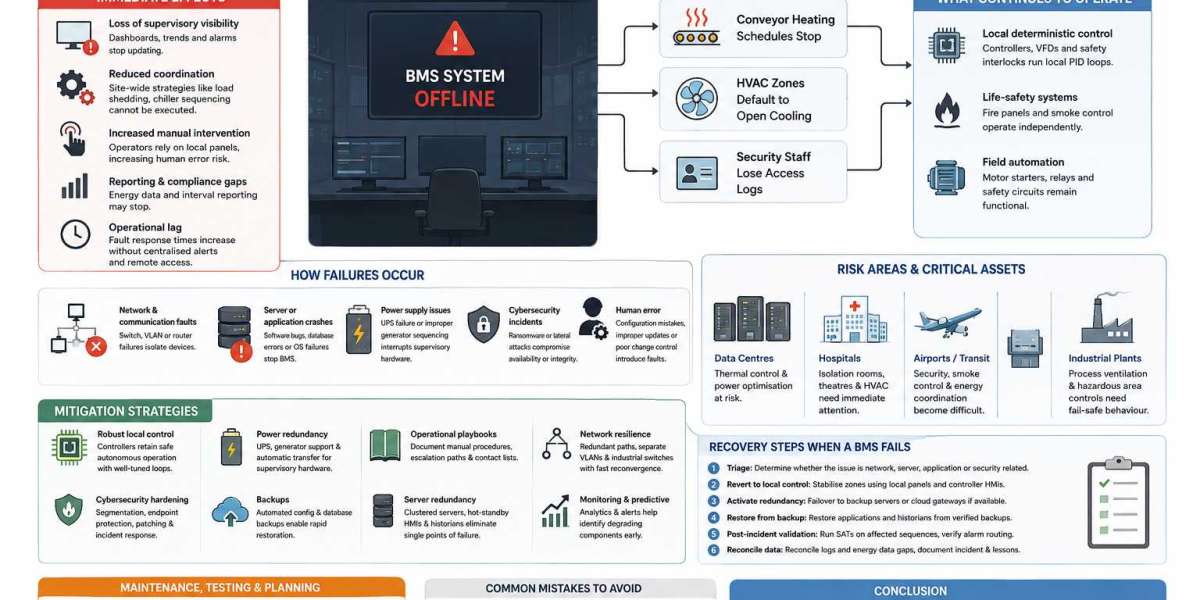

In a busy airport terminal, the central BMS dashboard goes dark during peak hours. Conveyer heating schedules stop, some HVAC zones default to open cooling, and security staff lose consolidated access logs. For a hospital or data centre, a similar failure could mean rapid temperature drift, compromised isolation rooms, or interruptions to generator coordination. Knowing what happens when a Building Management System fails — and how to design for resilience — separates manageable incidents from critical outages.
A Building Management System is the supervisory backbone that aggregates HVAC, lighting, power, fire and access systems into coordinated control and analytics. When that supervisory layer fails, field controllers may still run local logic, but operational visibility, cross-system coordination, energy optimisation and alarm escalation can be lost. Understanding failure modes, impacts, and mitigation strategies is essential for facility managers responsible for critical infrastructure and large commercial estates.
Immediate effects of BMS failure
- Loss of supervisory visibility: Trends, dashboards and centralized alarms stop updating, making fault diagnosis difficult.
- Reduced coordination: Site-wide strategies such as load shedding, chiller sequencing and demand response cannot be executed centrally.
- Increased manual intervention: Operators must revert to local panels and manual controls, increasing human error risk.
- Reporting and compliance gaps: Energy meters and interval data capture may cease, affecting regulatory reporting and contractual obligations.
- Operational lag: Without centralized alerts and remote access, response times for faults lengthen, impacting occupant comfort and safety.
What continues to operate
- Local deterministic control: Properly designed HVAC controllers, VFDs and safety interlocks continue executing embedded PID loops and local sequences.
- Life-safety systems: Fire panels and smoke control interlocks are typically hard-wired and operate independently to preserve safety functions.
- Field automation: Some motor starters and relay-based safety circuits remain functional without BMS supervision.
How failures occur
- Network and communication faults: Switch, VLAN or router failures can isolate supervisory servers from field controllers.
- Server or application crashes: Software bugs, corrupt databases, or OS failures can stop the BMS HMI and historian.
- Power supply issues: UPS failures or improper generator sequencing can interrupt supervisory hardware.
- Cybersecurity incidents: Ransomware or lateral attacks can compromise availability or integrity.
- Human error: Configuration mistakes, improper updates, or poor change control during maintenance can introduce faults.
Risk areas and critical assets
- Data centres: Loss of BMS supervision may degrade thermal control and power optimisation, risking thermal thresholds for IT racks.
- Hospitals: Isolation rooms, operating theatres, and HVAC linked to life-support areas require immediate attention.
- Airports and transit hubs: Security and energy coordination for large HVAC zones and smoke control become harder to manage.
- Industrial plants: Process ventilation and hazardous area controls need validated fail-safe behaviour.
Mitigation strategies — engineering and operational
- Robust local control: Ensure controllers retain safe autonomous operation with well-tuned PID loops and local fail-safe states.
- Network resilience: Use redundant network paths, separate management VLANs, and industrial switches with rapid reconvergence.
- Server redundancy: Implement clustered supervisory servers, hot-standby HMIs, and replicated historians to avoid single points of failure.
- Power redundancy: Maintain UPS, generator support and automatic transfer for supervisory hardware.
- Cybersecurity hardening: Segmentation, endpoint protection, patch management and incident response plans reduce attack surface.
- Regular backups: Automated configuration and database backups enable rapid restoration after software incidents.
- Clear operational playbooks: Document manual control procedures, escalation paths, and contact lists for out-of-hours response.
Recovery steps when a BMS fails
- Triage: Determine whether the issue is network, server, application, or security related.
- Revert to local control: Empower trained on-site staff to stabilise zones using local panels and field controller HMIs.
- Activate redundancy: Failover to backup servers or cloud gateways if available.
- Restore from backup: If corruption is identified, restore applications and historians from verified recent backups.
- Post-incident validation: Run SATs on affected sequences, verify alarm routing, and reconcile energy data gaps.
Maintenance, testing and planning to reduce failure impact
- Include redundancy and failover tests in factory acceptance tests (FAT) and site acceptance tests (SAT).
- Exercise disaster recovery and incident response plans annually.
- Use predictive analytics as part of BMS maintenance services to flag degrading components before they fail.
- Keep firmware and software on supported versions and apply security patches within change-controlled windows.
- Ensure staff training includes manual operation of BMS control panels and standard operating procedures during outages.
Procurement and lifecycle considerations
- Design resilience into procurement: request documented redundancy, refer to proven projects from your chosen BMS company, and verify support for hot-standby architectures.
- Evaluate total lifecycle value: after-sales support, comprehensive AMC offerings, and prompt remote support matter more than the lowest upfront cost.
- For critical facilities such as a data center BMS system, require detailed SLAs for response time, restoration and on-site assistance.
Common mistakes to avoid
- Assuming the BMS is indispensable for all controls; poorly designed systems fail unsafe.
- Neglecting regular backups and failover verification.
- Overlooking cybersecurity hygiene and network segmentation.
- Skipping manual operation training for operations staff.
- Selecting vendors without robust demonstrated resilience in real projects.
Conclusion
A Building Management System failure does not automatically shut down a building, but it removes the supervisory layer that delivers visibility, coordination, energy optimisation and centralised alarm handling. Engineering for resilient local control, redundant servers and networks, robust cybersecurity, verified backups, and well-practised recovery procedures are essential to limit operational impact. Selecting experienced integrators during BMS system installation and investing in proactive BMS maintenance services ensures continuity, regulatory compliance, and occupant safety — preserving comfort and critical infrastructure reliability when incidents occur.