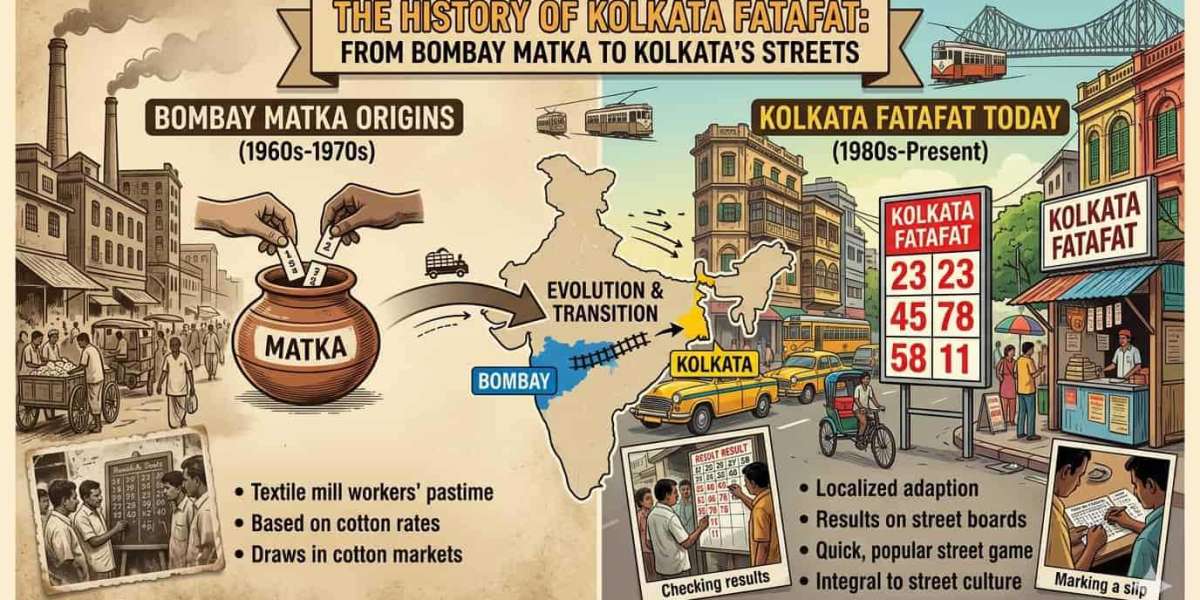

Kolkata Fatafat, popularly known as Kolkata FF, is one of the most followed number-based lottery games in West Bengal today. However, its origin and history are deeply connected to the legendary Bombay Matka game, which started in the city of Bombay (now Mumbai) several decades ago. Understanding the historical journey of Kolkata Fatafat — from its Bombay Matka roots to becoming a popular street-level game in Kolkata is important for every reader and follower of the game. This article explains the complete history of Kolkata Fatafat in a clear, simple, and easy-to-understand manner.
Summary of Kolkata Fatafat History
Detail Information
Original Game Bombay Matka (Satta Matka)
Game Originator Ratan Khatri (widely known as the Matka King)
Year of Origin Around the 1960s
Origin City Bombay (now Mumbai)
Adapted Version Kolkata Fatafat (Kolkata FF)
Adapted City Kolkata, West Bengal
Bazis per Day (Mon–Sat) 8 rounds
Bazis per Day (Sunday) 4 rounds
Kolkata Fatafat History: A Brief Overview
Kolkata Fatafat is widely believed to be inspired by the original Bombay Matka game, which is considered the oldest form of number-based lottery game in India.
The Bombay Matka game was introduced and popularised in the city of Bombay during the 1960s by a person named Ratan Khatri, who is often referred to as the "Matka King".
In the early years, the result of the Bombay Matka game was based on the opening and closing rates of cotton transmitted from the New York Cotton Exchange.
After the cotton exchange stopped this practice, a new system was introduced in which numbered slips were drawn from an earthen pot known as a Matka, and the name of the game was derived from the same pot.
Over the years, the Matka game spread from Bombay to several other Indian cities, including Kolkata, where it slowly took a new local form.
In Kolkata, the game was modified into a faster, shorter-format version with multiple daily rounds, which came to be known as Kolkata Fatafat because the word "Fatafat" means "quickly" in both Bengali and Hindi.
Unlike the traditional Matka game, which had only a few rounds per day, Kolkata Fatafat introduced a unique format with 8 Bazis on weekdays and 4 Bazis on Sundays.
This faster and shorter format made the game extremely popular among the working-class population of Kolkata, Howrah, and surrounding districts of West Bengal.
From Bombay Matka to Kolkata Streets
The journey of the game began in the small bylanes and trading hubs of Bombay during the 1960s, where Bombay Matka was first introduced as a local number-based lottery game.
As the game gained popularity in Bombay, traders, daily-wage workers, and common people from different cities started following the format, which eventually reached Kolkata.
In Kolkata, the game was adapted to suit the city's fast-paced street culture, with shorter time intervals and multiple daily Bazis.
Over time, Kolkata Fatafat became a part of the everyday street culture of the city, with regular followers checking the result at fixed times throughout the day.
The local term "Fatafat", meaning quickly, perfectly described the nature of the game, where the result of one Bazi was declared every 1 hour and 30 minutes.
Today, Kolkata Fatafat is followed not only in Kolkata but also in Howrah, Hooghly, North 24 Parganas, South 24 Parganas, and other districts of West Bengal.
Why Kolkata Fatafat Became Popular Over Time
The simple format of selecting a single digit between 0 and 9 made the game easy to understand for new followers.
The short time gap between two Bazis kept the game active throughout the day, unlike the traditional Matka format.
The availability of online result-tracking portals and mobile applications made it easier for readers to check the Bazi result on time.
The historical connection with the original Bombay Matka game also gave Kolkata Fatafat a strong identity among traditional followers.
Important Note
The information shared in this article is based on widely known public history and is intended only for general awareness and informational purposes.
Kolkata FF is purely a game of luck and chance, and the result of every Bazi is completely random.
Participation in such number-based games may carry financial risk, and readers are advised to remain cautious.
The legal status of such games may vary across regions; readers should verify local rules and regulations before taking any decision.
Frequently Asked Questions
1. Who introduced the original Bombay Matka game?
The original Bombay Matka game was introduced by Ratan Khatri, who is widely known as the "Matka King".
2. When did the Bombay Matka game start?
The Bombay Matka game is believed to have started around the 1960s in the city of Bombay.
3. What does the word "Fatafat" mean?
The word "Fatafat" means "quickly" in both Bengali and Hindi, which describes the fast-paced format of the game.
4. How is Kolkata Fatafat different from Bombay Matka?
Kolkata Fatafat follows a faster format with 8 Bazis on weekdays and 4 Bazis on Sundays, while traditional Matka had only a few rounds per day.
5. Where is Kolkata Fatafat mostly followed today?
Kolkata Fatafat is mostly followed in Kolkata, Howrah, Hooghly, North 24 Parganas, South 24 Parganas, and other districts of West Bengal.