
Entity SEO Audit Using Screaming Frog for AI Search Visibility
Introduction
AI-powered search systems increasingly rely on entities and their relationships to understand content. Instead of matching pages primarily through keywords, modern search engines evaluate people, organizations, products, places, and concepts as identifiable entities connected within a larger knowledge graph.
This shift makes entity optimization an important part of technical and semantic SEO. An Entity SEO Audit helps identify how well a website communicates its entities and relationships to search engines and AI systems.
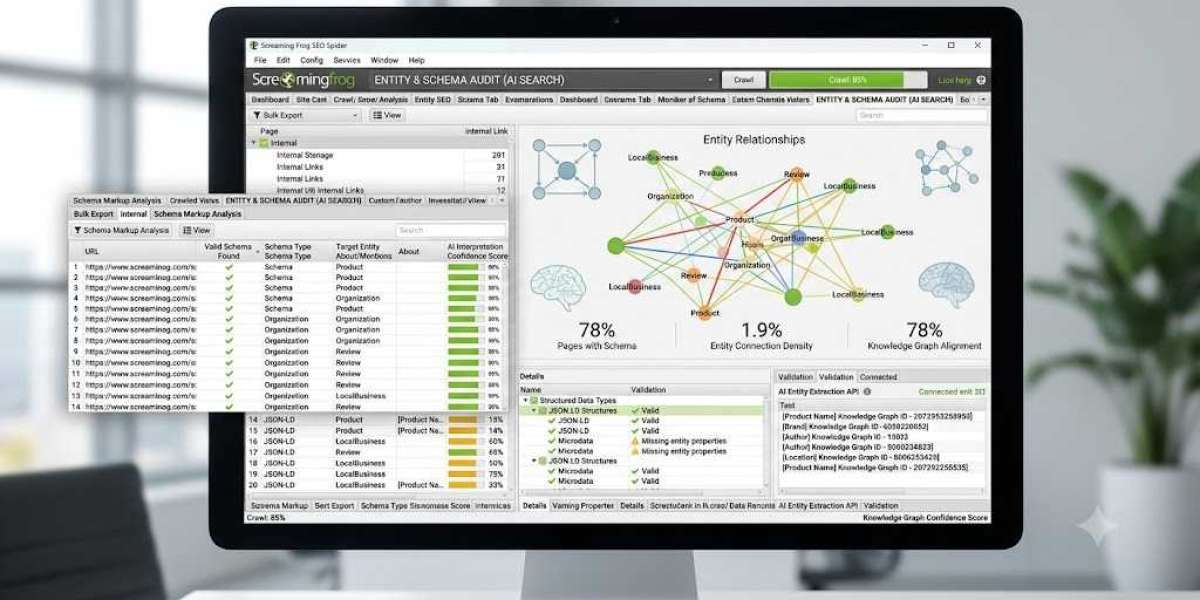
Screaming Frog is one of the most useful tools for this process because it can crawl websites, extract structured data, analyze internal linking, and reveal gaps that affect entity understanding.
This guide explains how to use Screaming Frog to evaluate entity signals and improve AI search visibility.
Quick Summary
An Entity SEO Audit examines how search engines identify and connect entities across a website. Using Screaming Frog, you can analyze schema markup, entity relationships, internal links, content structure, and supporting signals that help AI-driven search systems understand website content more accurately.
Foundations of Entity SEO
What Is an Entity in SEO?
An entity is a uniquely identifiable thing, such as a person, company, product, location, or concept. Search engines use entities to understand meaning beyond simple keyword matching.
For example, a search engine can recognize a company as an organization entity and connect it to its products, founders, and industry.
How Search Engines Understand Entities via Knowledge Graphs
Knowledge graphs organize entities and their relationships. Search engines use these systems to determine how different concepts connect to one another.
When entity signals are clear, search engines can better understand context and relevance.
Why AI Search Engines Rely on Entity Relationships Instead of Keywords
AI search systems evaluate meaning and context. Entity relationships help them understand how topics connect rather than relying solely on repeated keywords.
Strong entity relationships often improve content interpretation and retrieval.
Preparing Screaming Frog for Entity SEO Audits
Enabling Structured Data Extraction
Enable structured data extraction within Screaming Frog to collect schema markup during a crawl. This allows you to review entity-related information across the entire website.
Setting Up Custom Extraction for Entity Signals
Custom extraction can capture specific schema properties, entity references, and structured data elements that may not appear in standard reports.
Crawling JavaScript-Rendered Pages for Hidden Entities
Some entity information is generated through JavaScript. Rendering pages during crawling ensures that hidden schema and entity references are included in the analysis.
Exporting Entity-Level SEO Data for Analysis
Export crawl data into spreadsheets for deeper review. This helps identify missing markup, inconsistent entity references, and coverage gaps.
Structured Data and Schema Entity Analysis
Identifying Key Schema Types
Common schema types include Organization, Person, Product, Article, FAQPage, and LocalBusiness. These help define entities clearly for search engines.
Validating Entity Markup Accuracy
Review schema implementation to ensure entity names, URLs, and properties are accurate and consistent.
Checking sameAs Links and External Entity Connections
The sameAs property helps connect website entities to recognized external sources such as:
These references strengthen entity confirmation.
Detecting Missing or Weak Schema Properties
Missing descriptions, URLs, logos, or social profiles can weaken entity recognition. Screaming Frog can help identify incomplete markup.
Entity Coverage and Content Mapping
Mapping Primary vs Supporting Entities Across Pages
Each page should have a clearly defined primary entity. Supporting entities should reinforce the topic without creating confusion.
Identifying Missing Contextual Entities in Content
An Entity SEO Audit should evaluate whether important supporting entities are missing from relevant pages.
Evaluating Topic Clusters and Entity Relationships
Related pages should support one another through logical entity connections. Topic clusters often improve semantic clarity.
Comparing Entity Distribution Across Website Sections
Review how entities appear across blogs, service pages, product pages, and informational content to identify inconsistencies.
Internal Linking and Semantic Relationships
Analyzing Contextual Internal Links Between Entities
Internal links help establish relationships between entities and topics.
Detecting Orphan Pages with No Entity Connections
Pages without internal links may become isolated from the site's semantic structure.
Strengthening Semantic Link Paths Between Topics
Connect related entities using descriptive anchor text that reflects the relationship between topics.
Improving Crawl Flow for Important Entity Pages
Important entity pages should be easy for both users and crawlers to access.
Suggested internal links:
- Internal Link: Understanding Knowledge Graphs
- Internal Link: Schema Markup Best Practices
- Internal Link: Technical SEO Crawl Analysis
Content Structure for Machine Understanding
Heading Hierarchy and Semantic Clarity
Clear heading structures help search engines identify content organization and entity importance.
Use of Lists, Tables, and Structured Blocks
Structured formatting improves content interpretation and extraction.
FAQ Sections for Entity Reinforcement
FAQ sections often provide additional context around entities and their relationships.
Content Organization Signals for AI Crawlers
Consistent page organization makes entity identification easier for AI systems.
External Tools for Entity Validation
Several tools can complement an Entity SEO Audit:
- Google Rich Results Test: https://search.google.com/test/rich-results
- Schema Markup Validator: https://validator.schema.org
- Wikidata: https://www.wikidata.org
- Google Natural Language API: https://cloud.google.com/natural-language
- InLinks: https://inlinks.com
These tools help validate entity markup and identify additional optimization opportunities.
Step-by-Step Entity SEO Audit Workflow
Step 1: Full Website Crawl with Screaming Frog
Run a complete crawl with schema extraction enabled.
Step 2: Extract and Analyze Structured Data
Review entity markup across all crawled URLs.
Step 3: Map Entities and Relationships
Document primary entities and supporting entity connections.
Step 4: Identify Gaps and Weak Signals
Look for missing schema, incomplete properties, weak internal linking, and inconsistent references.
Step 5: Fix Issues and Optimize Entity Coverage
Update markup, strengthen relationships, and improve content context where needed.
Step 6: Monitor Improvements Over Time
A recurring Entity SEO Audit helps maintain consistency as content grows.
Common Entity SEO Mistakes
Missing or Incorrect sameAs Implementation
Incorrect external references can reduce entity clarity.
Weak or Unlinked Entity Mentions
Mentioning entities without context or connections limits their value.
Orphan or Isolated Content Pages
Disconnected pages weaken semantic relationships.
Inconsistent Organization or Brand Markup
Entity details should remain consistent across all pages.
Duplicate or Conflicting Entity References
Conflicting information can create ambiguity for search engines.
Conclusion
AI search systems increasingly depend on entities to understand content and relationships. An Entity SEO Audit helps identify technical and semantic issues that affect this understanding.
Screaming Frog provides valuable visibility into schema markup, internal linking, entity coverage, and content structure. When combined with validation tools and ongoing monitoring, it becomes easier to strengthen entity signals across a website.
Regular audits support clearer entity relationships and improve long-term AI search visibility.
FAQs
How do I audit website entities using Screaming Frog?
Enable structured data extraction, crawl the website, export entity-related data, and review schema markup, internal links, and content relationships.
Which schema types matter most for entity SEO?
Organization, Person, Product, Article, FAQPage, and LocalBusiness are among the most commonly used entity-related schema types.
What is the difference between keyword SEO and entity SEO?
Keyword SEO focuses on matching search terms, while entity SEO focuses on helping search engines understand identifiable concepts and their relationships.
Can Screaming Frog detect Knowledge Graph relationships?
Screaming Frog can identify structured data and entity signals, but it does not directly display Knowledge Graph relationships.
Which tools should be used alongside Screaming Frog?
Google Rich Results Test, Schema Markup Validator, Wikidata, Google Natural Language API, and InLinks are commonly used for additional validation.
How often should an entity SEO audit be performed?
Most websites benefit from conducting an audit every three to six months or after significant content and structural changes.
Further reading: optimizewithsanwal